The Routes The World Left Behind
While the industry chased flying taxis, Dovetail Electric Aviation looked at the forgotten half of the sky — and found the fastest path to zero-emission flight.
- Subject
- David Doral
- Role
- Co-founder & CEO, Dovetail Electric Aviation
- Location
- Spain · Australia
- Issue
- The Disruptors Issue · July 2026 · 14 min
Over two decades, the airlines quietly retreated. Route by route, the short hops that stitched small towns to economic centres were cut — uneconomic on fuel-hungry turboprops, invisible on quarterly reports. Community airports fell silent. A sub-50-seat market that once animated entire regions became aviation's forgotten half.
NASA's Short-Haul Revitalisation Study put a number on the opportunity everyone else ignored: cut operating costs by 40 percent, and the number of commercially viable regional routes multiplies by an order of magnitude.
The founder story
In the mid-2010s, David Doral was an aerospace-technology executive watching the industry pour billions into electric vertical take-off — urban toys with distant timelines. He drew the opposite conclusion: electrification's first real impact would come not from new aircraft, but from old ones. Retrofit proven airframes with electric propulsion, and the economics of regional flight invert overnight. He found his co-founder in Aaron Shaw, an operator who had spent his career running exactly the small aviation businesses Dovetail intends to electrify.
DovePack — the battery, reinvented in fluid
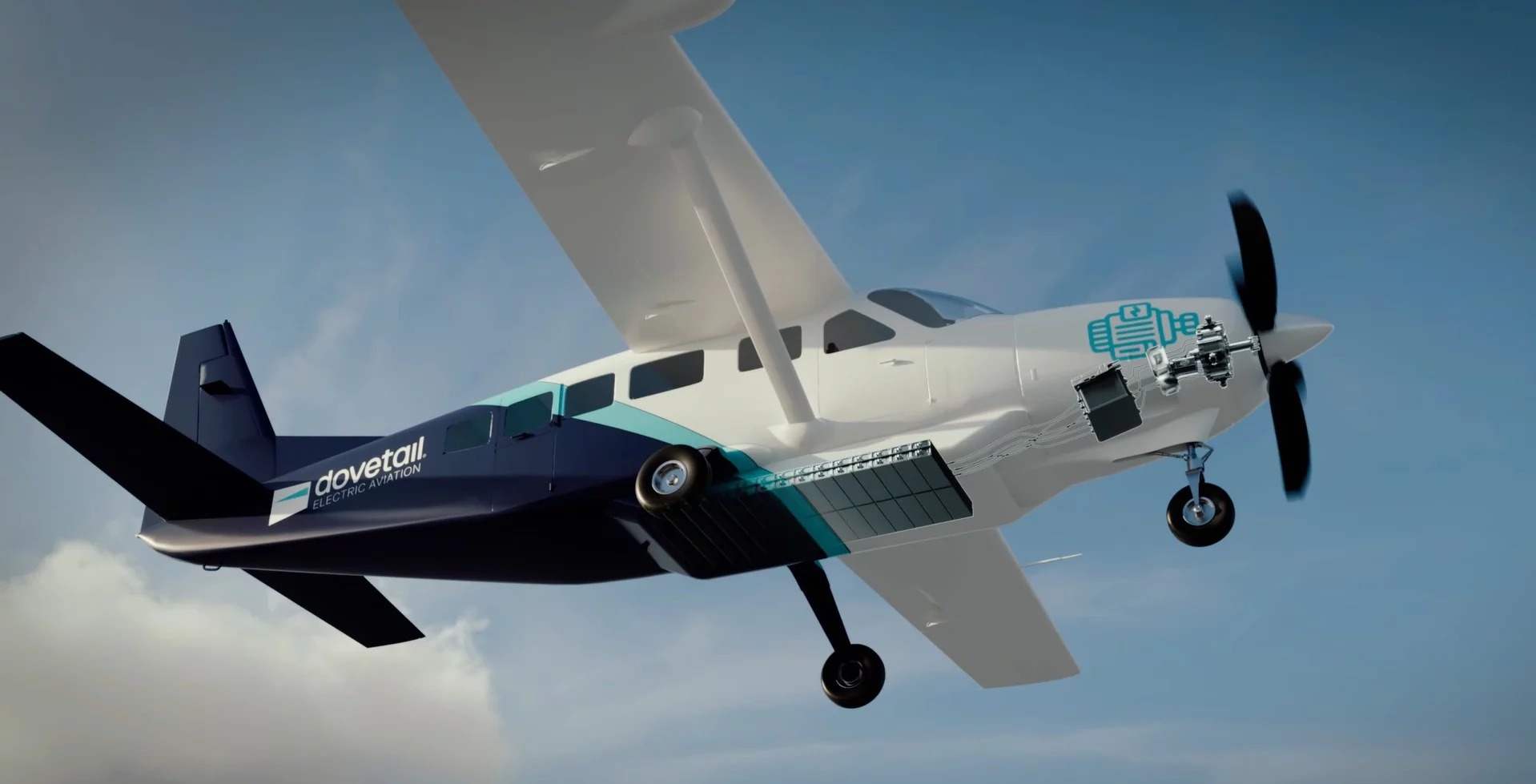
Aviation batteries fail on three fronts at once: heat, weight and fear. DovePack answers all three with a single idea — immerse every cell directly in a non-conductive cooling fluid. Direct-contact cooling dissipates heat far beyond what air or cold plates achieve, and the fluid itself acts as a built-in fire suppressant. The architecture eliminates bulky heat sinks and pumps — weight that becomes range.
DovePower — one powertrain, every energy source
DovePower is propulsion as a platform: zero-emission on batteries, hybrid when paired with hydrogen fuel cells or a turbogenerator. The first commercial retrofit — a battery-electric Cessna Caravan 208 — flies late 2025, aiming to certify the world's first full electric retrofit propulsion system for commercial aircraft by 2027.
Certification is the product
A retrofit needs a Supplemental Type Certificate, not a full Type Certificate — roughly one-third of the time to market of a clean-sheet aircraft. Ground testing completes December 2025; first flight mid-2026; STC certification and entry into service in 2027.
Business impact
Revenue stacks in layers: battery packs first — full-size prototypes already exist — then stand-alone propulsion systems, then complete retrofit kits. Recurring battery replacement and servicing captures a stream that once belonged to oil companies. First movers are leisure, skydiving and scenic operators; air ambulance and defence follow; regional airlines run pilots to anticipate their future fleets.
Editorial opinion
Dovetail's genius is restraint. While the industry chased moonshots, it chose the unglamorous path — old airframes, new propulsion, faster certification — and may reach zero-emission commercial flight before anyone else. The forgotten half of aviation could end up leading all of it. Pragmatism, it turns out, is the most radical strategy in aviation. The revolution will be retrofitted.
“Incumbents protect the status quo. Start-ups have to be the ones who move.”